
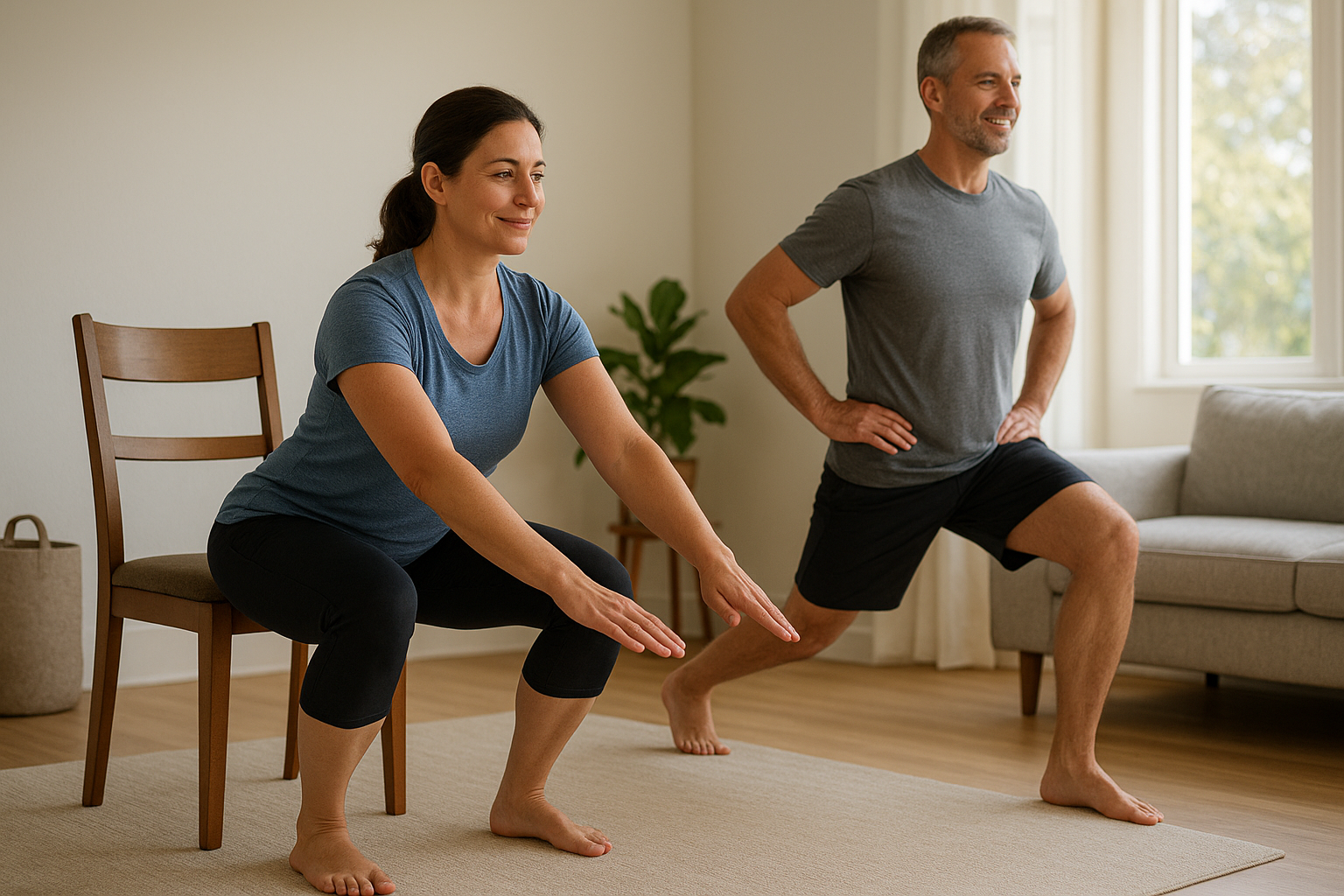
Mobility is the ability to move your joints through a comfortable, controlled range of motion. It is different from flexibility: flexibility is how far a muscle can lengthen, while mobility also involves joint control, strength, coordination, and stability.
For adults over 40, regular mobility work can make everyday tasks feel easier, from reaching into a cupboard and turning to check traffic to squatting down, walking uphill, and exercising with better form. The goal is not to force your body into extreme positions. Instead, use gentle, repeatable movements that help you maintain the range of motion you need for daily life.
Why Mobility Matters After 40
Changes in activity levels, long periods of sitting, old injuries, stress, and normal aging can all affect how freely your body moves. Stiffness does not always mean something is wrong, but it can make exercise and daily movement feel less comfortable.
A consistent mobility routine may help you:
- Prepare your joints and muscles for walking, strength training, or other exercise
- Improve body awareness and movement control
- Maintain comfortable movement for daily tasks
- Support balance and coordination
- Reduce the feeling of stiffness after sitting for long periods
Mobility exercises should feel controlled and manageable. Mild muscular effort or a gentle stretch sensation can be normal, but sharp pain, pinching, numbness, dizziness, or pain that worsens afterward is a sign to stop and seek guidance from a qualified healthcare professional.
How Often Should Adults Over 40 Do Mobility Exercises?
Short, frequent sessions are often more useful than an occasional long session. Aim for 5 to 10 minutes most days, or use these movements as part of your warm-up before strength training, walking, cycling, or fitness classes.
Move slowly, breathe normally, and stay within a pain-free range. Start with one set of 5 to 10 controlled repetitions per side. As the movements become more familiar, you can gradually add repetitions or spend a little more time in each position.
Best Mobility Exercises for Adults Over 40
1. Cat-Cow for Spinal Mobility
Cat-cow is a gentle way to move the spine through flexion and extension. It can be especially helpful after prolonged sitting.
- Start on your hands and knees with your hands under your shoulders and knees under your hips.
- As you inhale, gently lift your chest and tailbone while allowing your belly to lower slightly.
- As you exhale, press the floor away, round your upper back, and gently tuck your chin.
- Move slowly for 6 to 10 repetitions.
Modification: If getting to the floor is uncomfortable, perform the movement seated in a chair with your hands resting on your thighs.
2. Open-Book Rotations for the Upper Back
Thoracic spine rotation supports comfortable turning, reaching, and posture. The open-book exercise targets the upper and middle back while keeping the movement controlled.
- Lie on your side with your knees bent and stacked, arms straight in front of you.
- Keep your knees together as you slowly open your top arm across your body.
- Allow your chest to rotate gently toward the floor behind you.
- Pause for a comfortable breath, then return to the starting position.
- Complete 5 to 8 repetitions per side.
Tip: Do not force your shoulder to reach the floor. Let your range improve gradually over time.
3. Wall Shoulder Slides
Shoulder mobility is important for reaching overhead, dressing, lifting, and strength-training movements. Wall slides encourage shoulder movement while helping you keep your rib cage and posture under control.
- Stand with your back against a wall, feet a few inches forward.
- Place your arms against the wall in a comfortable bent-arm position.
- Slowly slide your arms upward as far as you can without pain or excessive arching in your lower back.
- Lower with control and repeat for 6 to 10 repetitions.
Modification: If keeping your arms on the wall is difficult, stand slightly farther away and use a smaller range of motion.
4. Hip Circles
The hips are involved in walking, climbing stairs, getting up from chairs, and many strength exercises. Hip circles are a simple way to explore motion in several directions.
- Stand near a wall or chair for support.
- Shift your weight into one leg and lift the opposite knee to a comfortable height.
- Draw slow, controlled circles with the lifted knee.
- Perform 5 circles in each direction, then switch sides.
Tip: Keep the movement small at first. Avoid twisting or leaning excessively through your lower back.
5. 90/90 Hip Switches
This floor exercise works on hip rotation, which can be limited by extended sitting and may be useful for people who want to improve squat, lunge, and walking mechanics.
- Sit on the floor with both knees bent and your feet wider than hip-width apart.
- Let both knees drop gently to one side, creating a comfortable 90/90-style position.
- Use your hands behind you for support if needed.
- Slowly rotate both knees through the middle and toward the opposite side.
- Continue for 5 to 8 controlled switches per side.
Modification: Sit on a folded towel, yoga block, or firm cushion to make the position more comfortable. If floor sitting is not appropriate for you, try standing hip circles instead.
6. Half-Kneeling Hip Flexor Rock
Many adults spend substantial time seated, which can leave the front of the hips feeling restricted. This exercise combines a gentle hip flexor stretch with active pelvic control.
- Start in a half-kneeling position with one knee on a padded surface and the other foot in front.
- Gently tuck your pelvis as if bringing your belt buckle slightly upward.
- Keeping your torso tall, shift forward a small amount until you feel a mild stretch at the front of the hip on the kneeling side.
- Rock back to the start and repeat 6 to 10 times before switching sides.
Tip: Keep the range small. Leaning too far forward can turn this into a lower-back movement rather than a hip-focused exercise.
7. Ankle Dorsiflexion Rocks
Comfortable ankle movement supports walking, stairs, balance, squatting, and getting up from low seats. Limited ankle mobility can also encourage compensation at the knees, hips, or lower back.
- Stand facing a wall with one foot a few inches from the wall.
- Keep your heel down as you gently drive your knee forward toward the wall.
- Stop before your heel lifts or you feel pain.
- Return to the starting position and repeat for 8 to 12 repetitions per side.
Progression: If your knee easily reaches the wall with your heel down, move your foot slightly farther back.
8. Supported Deep Squat Hold
A supported squat can help you practice ankle, knee, and hip mobility together. It also builds confidence in moving up and down from lower positions.
- Hold onto a sturdy countertop, door frame, or suspension trainer for support.
- Stand with your feet about shoulder-width apart or slightly wider.
- Lower into a comfortable squat while keeping your heels grounded as much as possible.
- Pause for 10 to 20 seconds while breathing steadily, then stand back up.
- Repeat 2 to 4 times.
Modification: Place a chair behind you and squat only to a depth that feels stable. You can also put a small wedge or folded towel under your heels if needed.
9. Controlled Neck Rotations
Neck mobility can be useful for driving, working at a computer, and maintaining comfortable posture. This movement should be especially gentle.
- Sit or stand tall with your shoulders relaxed.
- Slowly turn your head to look over one shoulder without forcing the motion.
- Return to center, then turn to the other side.
- Repeat 5 to 8 times per side.
Important: Avoid full neck circles, fast movements, or pushing through pain. Speak with a healthcare professional if neck movement causes dizziness, tingling, weakness, or persistent pain.
A Simple 10-Minute Mobility Routine
Use this routine in the morning, after sitting, or before a workout. Move at a comfortable pace and use support when needed.
- Cat-cow: 8 repetitions
- Open-book rotations: 6 repetitions per side
- Wall shoulder slides: 8 repetitions
- Hip circles: 5 circles each direction per side
- 90/90 hip switches: 6 repetitions per side
- Ankle dorsiflexion rocks: 10 repetitions per side
- Supported squat hold: 2 rounds of 15 to 20 seconds
If you are new to mobility work, choose just three or four exercises and build from there. Consistency is more valuable than trying to complete every exercise at once.
How to Make Mobility Training More Effective
- Pair it with an existing habit: Do a few movements after brushing your teeth, before your walk, or during a break from desk work.
- Use active control: Rather than passively hanging in a stretch, gently move into and out of a comfortable range.
- Train strength too: Mobility is often easier to maintain when you build strength through the range of motion you have.
- Pay attention to asymmetries: It is common for one side to feel different. Work both sides, but do not force them to match perfectly.
- Progress gradually: Small improvements over weeks and months are more sustainable than aggressive stretching sessions.
When to Get Professional Advice
Mobility exercises are not a replacement for medical assessment or rehabilitation. Consider consulting a physician, physical therapist, or qualified exercise professional if you have a recent injury, joint replacement, uncontrolled medical condition, significant arthritis symptoms, unexplained swelling, recurring falls, or pain that limits normal activities.
Conclusion
The best mobility exercises for adults over 40 are the ones you can perform consistently, comfortably, and with good control. Focus on common problem areas such as the shoulders, upper back, hips, ankles, and spine. A few minutes of regular movement can support an active routine and make it easier to keep doing the activities you enjoy.

